Trading Checklist: Forex Trading Plan and Pre-Trade Checklist
Two checklists in one: a 10-point forex trading plan checklist to review before going live, and a 9-question pre-trade checklist to use before every trade.
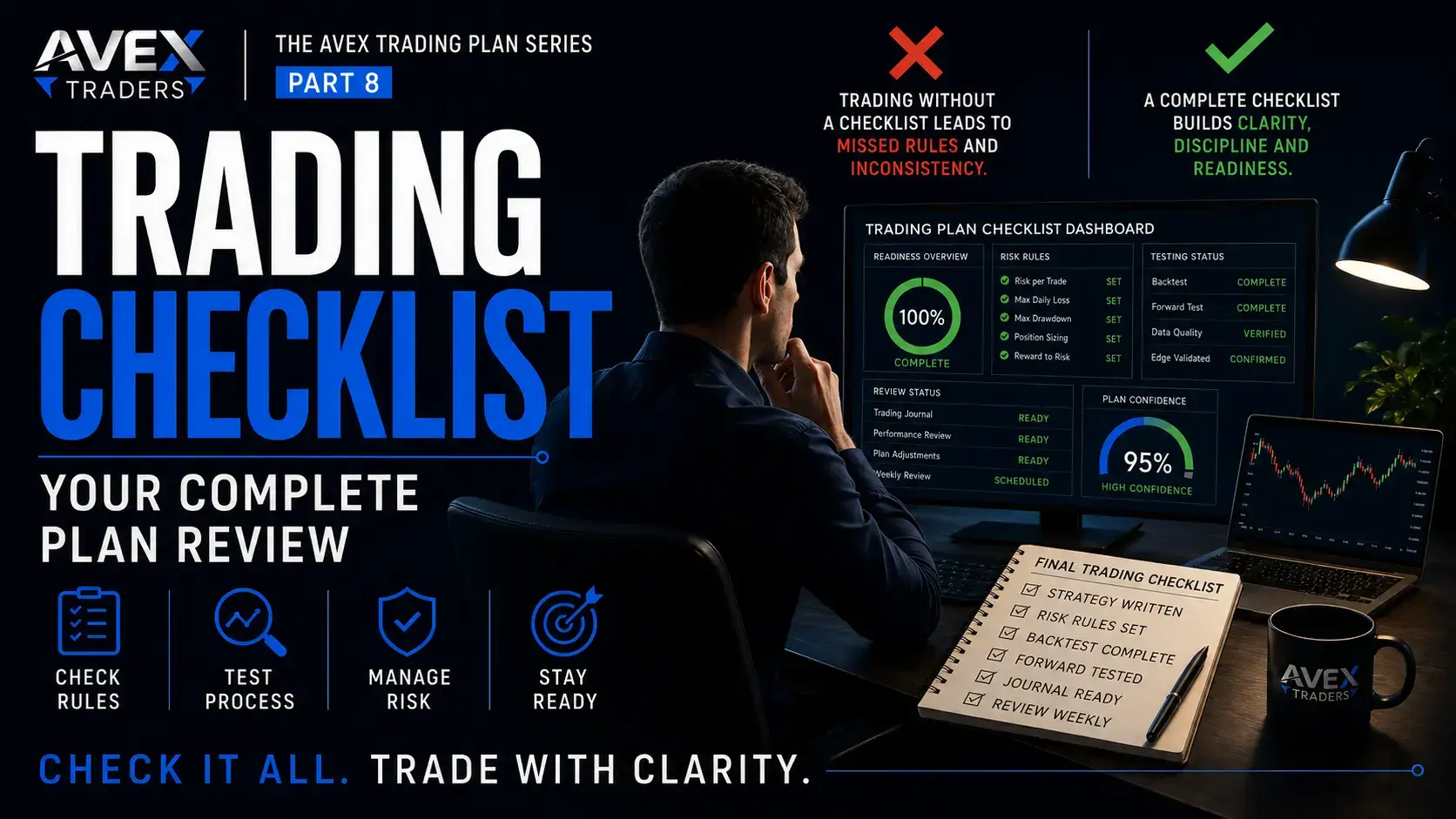
A trading checklist is the simplest tool that separates professional traders from impulsive ones.
Pilots use checklists before every flight, no matter how many hours they have flown. Not because they forget how to fly, but because pressure makes people skip steps. Trading is the same.
This page gives you two checklists in one:
- The forex trading plan checklist: ten points to review before you risk real money.
- The pre-trade checklist: nine questions to answer before every single trade.
Copy them, print them, and keep them next to your screen.
What Is a Trading Checklist?
A trading checklist is a short written list of conditions you must confirm before you act. A trading plan checklist confirms that your strategy, risk rules and testing are complete before you go live. A pre-trade checklist confirms that one specific trade matches your rules before you enter. If any answer is "no" or "not sure", you do not trade.
The Pre-Trade Checklist (Copy This)
Answer these nine questions before every trade. All nine must be "yes".
- Does this setup match my written strategy?
- Am I inside my planned trading session?
- Is there no major news due in the next 30 minutes?
- Is my risk per trade correct and position size calculated?
- Is my stop loss placed at a logical level before entry?
- Is my target clear, with an acceptable reward-to-risk?
- Am I under my daily loss limit and maximum number of trades?
- Am I calm, and not chasing or trying to win back a loss?
- Would I be comfortable writing this trade in my journal exactly as it is?
If the answer is not clear, do not trade. No setup is worth breaking your process.
Part 1: The Forex Trading Plan Checklist (Before Going Live)
Many traders go live too quickly. They learn a setup, take a few trades, feel confident, and then the market applies pressure. The missing parts become obvious: no written rules, no testing, no clear risk, no journal.
Work through these ten points first. Together, they bring the full Avex Trading Plan Series into one review.
1. Is your strategy written down?
Not remembered. Not guessed. Written. It should answer: what market, what timeframe, what setup, what confirms entry, where the stop goes, where the target is, when you stay out, and how you manage the trade. If you are starting here, read what a trading strategy is and why every trader needs one.
2. Is the strategy personal to you?
It must fit your personality, patience, schedule, screen time and risk comfort. Blindly copying another trader rarely works, as we explain in why you should not copy another trader's strategy. A strategy you cannot follow is useless, even if it looks profitable on paper.
3. Have you backtested it?
You should know your win rate, average reward-to-risk, longest losing streak, best and worst conditions, and how often the setup appears. Backtesting does not guarantee future results, but it gives you evidence instead of belief. See how to backtest a trading strategy.
4. Have you optimised without overcomplicating?
Remove weak setups and filters that create confusion. Good optimisation makes the strategy cleaner and reduces hesitation. More in how to optimise a trading strategy.
5. Is your trading plan written?
A strategy gives trade rules. A trading plan gives behavior rules. Your plan should include your goal, session times, markets, risk per trade, daily and weekly loss limits, maximum trades per day, rules after a loss and after a win, and your review schedule.
6. Are your risk rules clear?
Risk per trade is defined, position size is calculated, the stop is placed before entry, reward-to-risk is acceptable, and you never raise risk emotionally. Risk management matters more than the perfect entry. It is what keeps you in the game.
7. Have you forward tested?
Trade the plan in current market conditions, on demo or very small size, for at least two weeks. The goal is not profit. The goal is proving behavior: did you follow the plan, respect risk and journal every trade? See forward testing before live trading.
8. Is your trading journal ready?
Track setup, entry, exit, risk, result, screenshot, emotion, mistake and lesson for every trade. Without a journal, improvement is guesswork. Our guide to using your trading journal as a coach shows how.
9. Do you have a pre-trade checklist?
Use the nine questions above, or adapt them to your strategy. Keep it short enough that you actually use it on every trade.
10. Do you know when to stop?
Define when you stop after losses, after reaching your target, under emotional pressure, when focus is poor, and when the market is unclear. Stopping is not weakness. It is discipline. Sometimes the best trade is no trade.
The Post-Trade Checklist (After Every Trade)
A checklist does not end at entry. After each trade closes, answer these five questions in your journal:
- Did I follow every point of my pre-trade checklist?
- Did I manage the trade according to my plan, without moving the stop?
- What did I feel before, during and after the trade?
- Was the result caused by the market, or by my execution?
- Is there one lesson to carry into the next trade?
Once a week, review all your trades together. An AI trading coach can help you spot patterns you may miss.
Example: A Gold Trade Through the Checklist
Imagine a trader whose strategy is: trade XAUUSD on the 5-minute chart during the London session, enter on a pullback to a rising moving average after a break of structure, risk 0.5% per trade, minimum 1:2 reward-to-risk.
- Setup matches the strategy: yes, a clean pullback after a break of structure.
- Inside the session: yes, 09:30 London time.
- News: no, US CPI is due in 20 minutes.
The checklist stops here. The setup looks good, but question 3 fails, so the trader waits. That is the checklist doing its job: protecting the trader from a good-looking trade at a bad time.
Common Trading Checklist Mistakes
- Making it too long. Twenty-five items will be skipped under pressure. Keep the pre-trade list under ten questions.
- Ticking boxes without thinking. Say each answer honestly, especially the emotional questions.
- Changing it after a loss. Update your checklist during your weekly review, never in the middle of a session.
- Using someone else's checklist unchanged. Use this one as a template, then adapt it to your own strategy and market.
Frequently Asked Questions
What should be on a trading checklist?
A pre-trade checklist should confirm that the setup matches your strategy, you are in your session, there is no major news, your risk and position size are correct, your stop and target are set, you are within your daily limits, and you are emotionally calm.
How many items should a trading checklist have?
Between five and ten items for a pre-trade checklist. It must be short enough to use on every trade. Your full trading plan checklist can be longer because you only review it occasionally.
What is the difference between a trading plan and a trading checklist?
A trading plan is the full document that describes how you trade. A trading checklist is a short list taken from that plan, used to confirm you are following it at the moment of decision.
Does a trading checklist improve results?
A checklist cannot make a bad strategy profitable. What it does is stop impulsive and rule-breaking trades, which are among the most common reasons traders lose money with an otherwise sound plan.
Should I print my trading checklist?
Yes. A printed checklist next to your screen is harder to ignore than a file on your computer. Many traders also keep a copy in their journal template.
Final Thoughts
Trading is not only about finding entries. It is about building a repeatable process, and a checklist is how you protect that process when pressure rises.
For a wider view, Investopedia's guide to building a trading plan and BabyPips' trading plan lesson are useful references.
Write the rules. Test the rules. Follow the rules. Review the rules.
That is the process.