
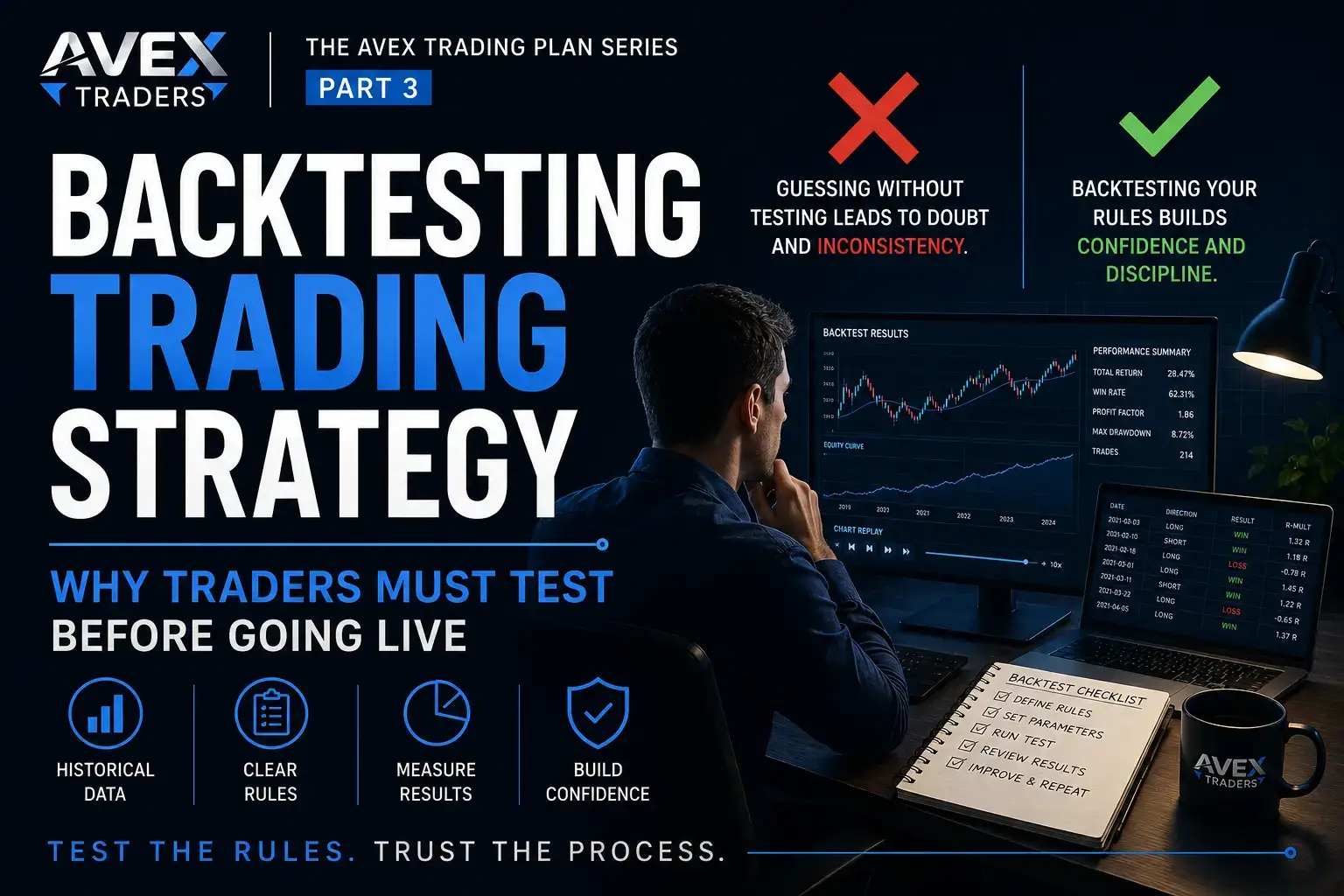
The Avex Trading Plan Series — Part 3
Series Note:
This is Part 3 of the Avex Trading Plan Series. In Part 1, we discussed why every trader needs written rules. In Part 2, we explained why copying another trader’s strategy can be dangerous. Now we move to the next step: backtesting.
Before backtesting, a trader must first create a written trading strategy with clear entry, exit, and risk rules.
In Part 2, we also explained why every trader needs a personal trading strategy instead of blindly copying another trader.
A backtesting trading strategy is the process of checking whether your rules worked in the past before you risk real money in the live market.
Backtesting trading strategy rules helps traders understand whether their setup has evidence, not just hope.
Many traders want to skip this step.
They learn a setup.
They watch a few examples.
They see one or two good trades.
Then they want to go live.
That is dangerous.
A trading idea is not a strategy yet.
A setup becomes a strategy only after it has been tested, measured, reviewed, and improved.
This is where backtesting becomes essential.
What Is Backtesting Trading Strategy?
Backtesting means taking your written trading rules and testing them on historical market data.
For general background, Investopedia explains backtesting as testing a strategy using historical data to see how it would have performed.
You go back on the chart.
You move forward candle by candle.
Every time your setup appears, you record the result.
You do not guess.
You do not choose only the beautiful examples.
You do not skip losing trades.
You test the strategy as if you were trading live.
The purpose is simple:
To find out whether the strategy has a positive result over a large enough sample.
Backtesting helps answer questions like:
- Does this setup actually work?
- Which session gives better results?
- Which market condition is best?
- What is the normal losing streak?
- What risk-to-reward works best?
- Where should the stop loss go?
- Where should the target go?
- Should this strategy be filtered or removed?
Without backtesting, you are trading based on belief.
With backtesting, you start trading based on evidence.
Why Backtesting Matters
Backtesting matters because live trading creates pressure.
When real money is involved, emotions become stronger.
A trader may hesitate.
A trader may close early.
A trader may move the stop loss.
A trader may avoid the next valid trade after a loss.
A trader may jump into a revenge trade after being stopped out.
Backtesting reduces this uncertainty.
It gives the trader confidence because the rules are already studied before the live market.
If you know from your backtest that your strategy can lose three trades in a row and still be profitable over time, you will not panic as quickly when those losses happen.
If you know your strategy performs better in New York than London, you will stop forcing trades in the wrong session.
If you know your best results come from trading range edges, you will stop chasing the middle of the range.
This is the real value of backtesting.
It does not remove losses.
It helps you understand them.
Backtesting Builds Trust in Your Rules
One of the biggest reasons traders abandon strategies is lack of trust.
They take one loss and think:
“Maybe the strategy does not work.”
They take two losses and think:
“I need a new setup.”
They miss one winning trade and think:
“I should change the rules.”
This happens because they do not have enough data.
Backtesting gives the trader a history with the strategy.
You see the wins.
You see the losses.
You see the days where nothing happens.
You see the trades that nearly hit target but reversed.
You see the trades that looked ugly but still worked.
This experience matters.
It creates ownership.
A copied strategy does not create confidence.
A tested strategy does.
Backtesting Should Be Done Candle by Candle
A common mistake is looking back on a chart and saying:
“I would have entered here.”
But that is not proper backtesting.
When you already see the future candles, your mind becomes biased.
Everything looks easier after the move has happened.
Proper backtesting should be done candle by candle.
You should move through the chart slowly, as if you are in the live market.
At each candle, you ask:
“Is my setup present?”
If yes, you record the trade.
If no, you wait.
This is important because backtesting should train execution, not imagination.
The closer your backtest feels to live trading, the more useful it becomes.
What You Should Record in a Backtest
A backtest should not be random.
You need a simple tracking sheet.
At minimum, record:
- Date
- Instrument
- Session
- Market condition
- Strategy name
- Entry reason
- Stop loss location
- Take profit location
- Risk-to-reward
- Result
- Notes
For example:
| Field | Example |
|---|---|
| Instrument | XAUUSD |
| Session | New York |
| Market condition | Trading range |
| Strategy | Range edge rejection |
| Entry | Buy from lower edge |
| Stop loss | Below range low |
| Target | Middle or opposite side |
| Result | +2R |
| Notes | Clean setup, no news |
This type of record helps you see the truth.
Not what you felt.
Not what you hoped.
The actual performance of the rules.
Test Different Market Cycles
A good backtest should separate different market conditions.
Price action is not always the same.
Sometimes the market is in a spike.
Sometimes it is in a channel.
Sometimes it is in a trading range.
Each condition behaves differently.
A strategy that works well in a trading range may perform badly in a strong spike.
A pullback strategy may work well in a channel but fail inside a choppy range.
This is why your backtest should record the market cycle.
Do not only ask:
“Did the trade win?”
Ask:
“What market condition did this trade appear in?”
This helps you understand where your strategy belongs.
A strategy does not need to work everywhere.
It needs to work clearly in the right condition.
Risk-to-Reward Must Be Tested
Many traders choose a target randomly.
They say:
“I will take 1:1.”
Or:
“I want 1:3.”
But risk-to-reward should not be chosen because it sounds good.
It should be tested.
Some strategies perform better with smaller targets.
Some strategies perform better when allowed to run.
Some setups hit 1:1 often but rarely reach 1:3.
Other setups may lose often but produce large winners when they work.
Backtesting helps you find the best balance.
For example, you may discover:
- 1:1 gives many wins but small growth
- 1:2 gives better balance
- 1:3 creates too many reversals before target
- 1:5 works only in strong trend days
This information is powerful.
It prevents random live-market decisions.
The decision is made before the trade, not during the pressure of the trade.
Backtesting Helps You Remove Weak Strategies
At the beginning, you may have many strategy ideas.
That is normal.
You may test:
- trading range breakouts
- fake breakouts
- channel pullbacks
- spike continuations
- range edge reversals
- trendline breaks
- candle rejection setups
But after testing, not all of them should survive.
Some ideas will perform poorly.
Some will work only in specific sessions.
Some will create too much drawdown.
Some will not fit your personality.
Backtesting helps you remove weak strategies.
This is important.
A trader does not need ten average strategies.
A trader needs one or two strategies that are clear, tested, and repeatable.
The goal is not to collect setups.
The goal is to reduce confusion.
Backtesting Is Also a Psychology Exercise
Backtesting is not only technical work.
It is also psychological training.
It teaches patience.
It teaches discipline.
It teaches the trader to follow rules even when the chart is tempting.
It shows how often the market gives no trade.
That is important because many traders overtrade simply because they are not comfortable waiting.
Backtesting trains the trader to wait for the setup.
It also reveals whether the trader is honest.
If you skip losses in backtesting, you will not trust the result.
If you change the rules every few trades, you will not build a strategy.
If you only record winning examples, you are not testing.
You are comforting yourself.
Backtesting requires honesty.
Do Not Backtest Like a Perfectionist Forever
Backtesting is important, but it should not become an excuse to avoid execution forever.
Some traders stay in backtesting for months because they want the perfect strategy.
But no strategy is perfect.
A good backtest does not mean no losses.
It means the strategy has enough evidence to continue to the next stage.
The process should be:
Write the rules.
Backtest the rules.
Improve the rules.
Remove weak ideas.
Select the strongest version.
Then move to forward testing.
Forward testing is where the strategy meets the live market.
That will be Part 6 of this series.
For now, the goal of backtesting is to build evidence, not perfection.
Simple Backtesting Checklist
Before trusting a strategy, ask:
- Did I write the rules clearly?
- Did I test candle by candle?
- Did I record every valid setup?
- Did I include losing trades?
- Did I test different sessions?
- Did I separate market cycles?
- Did I compare risk-to-reward options?
- Did I calculate win rate and total R result?
- Did I identify normal losing streaks?
- Did I remove weak strategy ideas?
If the answer is no, the strategy is not ready yet.
Coming Next
In Part 4 of the Avex Trading Plan Series, we will discuss strategy optimisation.
Backtesting gives you the raw data. Optimisation helps you clean the strategy, add useful filters, remove weak setups, and move from many ideas toward one clear trading method.
Next article: How to Optimise a Trading Strategy Without Overcomplicating It
Series Navigation
Previous: Why You Should Not Copy Another Trader’s Strategy
Next: How to Optimise a Trading Strategy Without Overcomplicating It
Final Thought
Backtesting is not exciting.
It is not fast.
It does not give the same dopamine as live trading.
But it is one of the most important steps in a trader’s development.
Because backtesting turns opinion into evidence.
It turns ideas into rules.
It turns random setups into measured performance.
And most importantly, it gives the trader something to trust when live-market pressure begins.
If you have not tested your strategy, you do not truly know your strategy.
You only believe in it.
And belief is not enough.
Avex Traders
Do not rush to live trading.
Test the rules first.
Confidence should come from evidence, not hope.
Risk Disclosure: Trading forex, gold, and other leveraged products involves significant risk and may not be suitable for every trader. This article is for educational purposes only and does not constitute financial advice.