
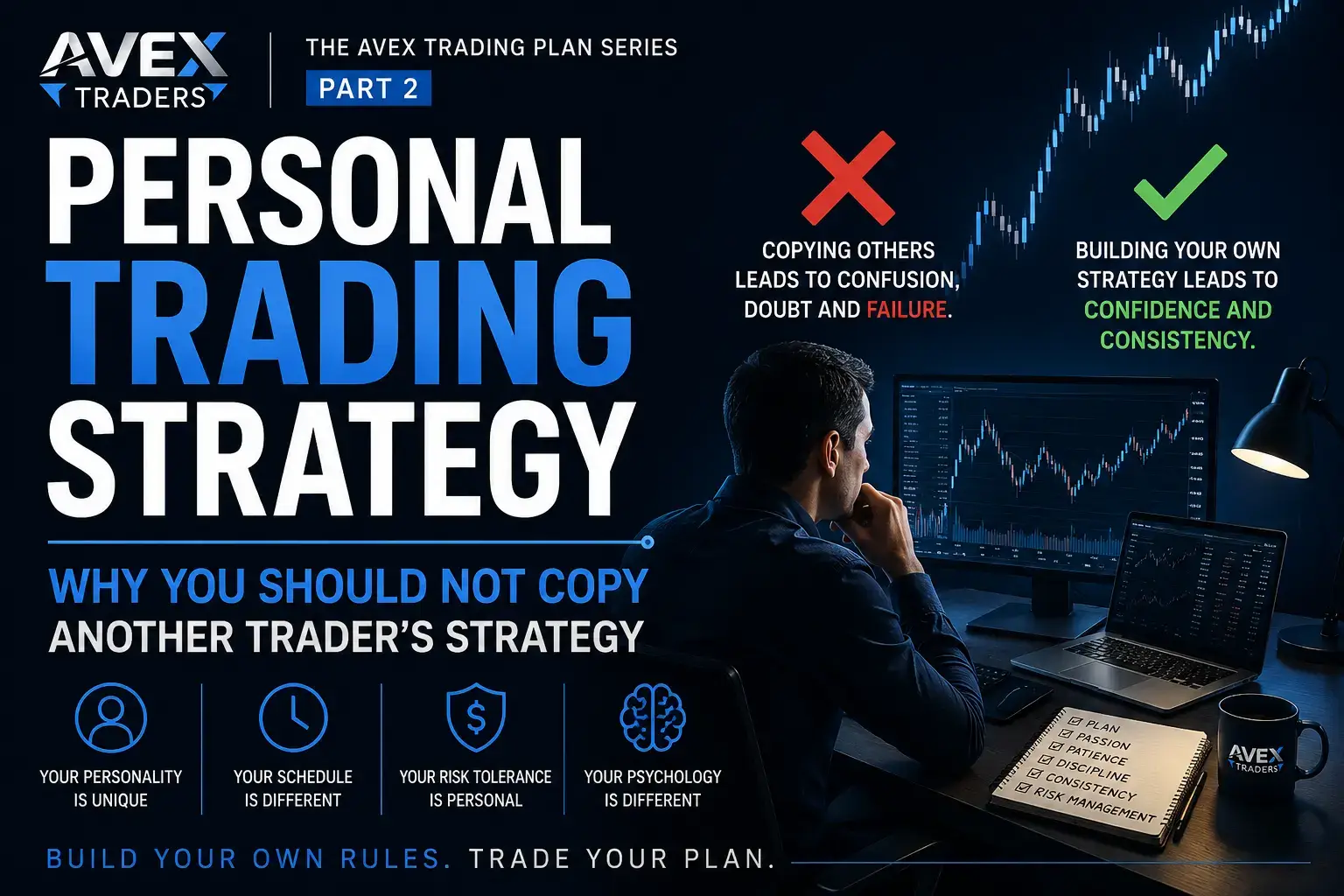
A personal trading strategy must fit the trader behind the screen, not just the chart setup.
The Avex Trading Plan Series — Part 2
Series Note:
This is Part 2 of the Avex Trading Plan Series. In Part 1, we discussed what a trading strategy is and why every trader needs written rules. In this article, we go one step deeper: why copying another trader’s strategy can be dangerous, and why your strategy must match your own personality, psychology, schedule, and risk tolerance.
Many traders are searching for the perfect strategy.
They watch YouTube videos.
They join Telegram groups.
They follow traders on Instagram.
They buy courses.
They save screenshots.
They ask, “What is your strategy?”
This is normal.
Every trader wants clarity.
But there is a problem.
A strategy that works for one trader may fail completely for another trader.
Not because the strategy is bad.
But because the trader is different.
That is why copying another trader’s strategy without testing and adapting it can become dangerous.
The Problem With Copying a Trading Strategy
When you copy another trader’s strategy, you usually copy the visible part.
You copy the entry.
You copy the chart setup.
You copy the pattern.
You copy the indicator.
You copy the stop loss and take profit.
But you do not copy the trader’s experience.
You do not copy their screen time.
You do not copy their emotional control.
You do not copy their patience.
You do not copy their risk tolerance.
You do not copy their ability to sit through drawdown.
You do not copy their years of backtesting.
You do not copy their confidence in the setup.
That is the missing part.
A strategy is not only technical.
A strategy is also psychological.
Two traders may use the same setup, but one follows the rules calmly and the other panics after one loss.
The chart may be the same.
But the result will not be the same.
For general background, Investopedia explains a trading strategy as a systematic method used to buy and sell in financial markets.
Why a Personal Trading Strategy Matters
Every trader has a different personality.
Some traders are fast and decisive.
They can trade spike movement, quick scalps, and short-term momentum.
Other traders need more time.
They prefer slower setups, trading ranges, swing trades, or higher timeframes.
Some traders enjoy fast decision-making.
Others become stressed when price moves quickly.
Some traders can wait for hours for one setup.
Others become impatient and start forcing trades.
This matters.
A trading strategy must fit the trader behind the screen.
If the strategy does not fit your personality, you may understand it technically but fail to execute it emotionally.
That is why personal strategy is important.
Same Market, Different Traders
Imagine three traders watching the same gold chart.
The market moves strongly upward.
Trader A sees a spike and wants to buy continuation.
Trader B sees price extended and waits for a pullback.
Trader C sees volatility and decides not to trade.
Who is right?
Maybe all three.
Because each trader may have a different strategy.
The spike trader needs speed.
The pullback trader needs patience.
The no-trade trader may be protecting their account because the move does not match their setup.
This is why trading is not only about the market.
It is about the relationship between the trader and the market.
The same chart can create different decisions for different traders.
Your Strategy Should Match Your Market Cycle
In price action, the market often moves through different cycles:
- spike
- channel
- trading range
Each cycle needs a different approach.
In a strong spike, buying in the direction of momentum may make sense.
In a channel, buying pullbacks or selling near the top may make sense depending on the structure.
In a trading range, the principle is usually different: buy low, sell high, and avoid the middle.
A trader who is comfortable with fast momentum may prefer spike strategies.
A patient trader may prefer trading range strategies.
A trader who likes structure may prefer channel pullbacks.
There is no single best cycle for everyone.
The best strategy is the one you can understand, test, and repeat with discipline.
Copy the Concept, Not the Exact Strategy
This is the better approach:
Do not blindly copy the full strategy.
Copy the concept.
Then test it.
Then adapt it.
For example, you may learn this concept:
“Buy near the bottom of a trading range after price shows rejection.”
That is a concept.
But your personal strategy must define the details:
- Which instrument?
- Which timeframe?
- Which session?
- What counts as rejection?
- Where is the stop loss?
- Where is the target?
- How many trades per day?
- What happens after two losses?
- Do you enter immediately or wait for confirmation?
- Do you trade before news or avoid it?
These details make the strategy yours.
Without these details, you are not trading a strategy.
You are trading an idea.
And ideas are not enough in live market conditions.
Why Backtesting Builds Ownership
One reason copied strategies fail is that the trader has no ownership.
They did not build the strategy.
They did not test it.
They did not see how it behaves during losing streaks.
They did not study how it performs in different market conditions.
So when the first few losses happen, doubt appears immediately.
The trader starts asking:
“Is this strategy still working?”
“Should I change it?”
“Maybe I need another setup.”
“Maybe this trader’s strategy does not work anymore.”
This is how strategy hopping begins.
Backtesting helps solve this problem.
When you test a strategy yourself, you start building trust.
You see the wins.
You see the losses.
You see the normal losing streaks.
You see when the strategy works best.
You see when it should be avoided.
That experience creates confidence.
Not blind confidence.
Tested confidence.
Your Schedule Matters
A strategy must also fit your lifestyle.
This is especially important for traders who work shifts, travel, or have limited screen time.
A strategy that needs six hours of screen time may not work for someone with a full-time job.
A fast scalping strategy may not suit someone who can only check charts two or three times a day.
A London session strategy may not work for someone who is always available only during New York.
This is why copying another trader blindly can create frustration.
Maybe their strategy works.
But maybe it works because they trade a different session, different timeframe, different instrument, and different lifestyle.
Your strategy must respect your real life.
If you only have one hour per day, build around that.
If you are tired after work, do not choose a strategy that requires fast emotional decision-making.
If you travel often, consider higher timeframes or alerts.
The best strategy is not the most impressive strategy.
It is the one you can actually follow.
Risk Tolerance Is Personal
Two traders can use the same setup but feel completely different emotions because of risk.
One trader may be calm risking 1%.
Another trader may feel stressed risking 0.5%.
Another trader may become reckless after a small win.
Another trader may freeze after one loss.
This is why risk rules must be personal.
A strategy is not complete until the risk fits your psychology.
If the risk is too high, even a good setup becomes difficult to execute.
You may close early.
You may move the stop loss.
You may avoid the next valid trade.
You may revenge trade after a loss.
This is not a strategy problem.
It is a trader-strategy mismatch.
Your strategy must be built around risk you can actually tolerate.
A Good Strategy Should Feel Clear, Not Exciting
Many traders search for exciting strategies.
Fast entries.
Big targets.
High win rates.
Impressive screenshots.
Dramatic account growth.
But excitement is not the goal.
Clarity is the goal.
A good trading strategy should feel clear.
You should know what you are waiting for.
You should know when the setup is invalid.
You should know when to stop.
You should know what to do after a loss.
You should know what to do after a win.
That clarity is what reduces emotional decision-making.
If your strategy makes you constantly confused, rushed, or emotionally unstable, it may not be the right strategy for you — even if it works for someone else.
The Real Question
Instead of asking:
“What strategy does this trader use?”
Ask:
“Can I execute this strategy with discipline?”
That is the real question.
Can you follow it after two losses?
Can you wait for the correct setup?
Can you accept the stop loss?
Can you avoid trades outside the rules?
Can you backtest it honestly?
Can you repeat it for 100 trades without changing everything?
If the answer is no, then it is not your strategy yet.
It may be a good idea.
It may be a useful concept.
But it is not your trading strategy until you have tested it, adapted it, and proven that you can execute it.
Coming Next
In Part 3 of the Avex Trading Plan Series, we will discuss backtesting.
Backtesting is where a trading idea starts becoming a real strategy. It helps traders test rules, study historical performance, understand losing streaks, improve filters, and build confidence before live trading.
Next article: Backtesting a Trading Strategy: Why Traders Must Test Before Going Live
Series Navigation
Previous: What Is a Trading Strategy and Why Every Trader Needs One
Next: Backtesting a Trading Strategy: Why Traders Must Test Before Going Live
Final Thought
You can learn from other traders.
You can study their setups.
You can take inspiration from their methods.
But you should not blindly copy their strategy.
Trading is personal.
Your strategy must fit your personality, risk tolerance, market understanding, schedule, and emotional control.
The goal is not to trade like someone else.
The goal is to build a process you can repeat with discipline.
Avex Traders
Do not search for a magic strategy.
Build a strategy that fits you, test it, and execute it with discipline.
Risk Disclosure: Trading forex, gold, and other leveraged products involves significant risk and may not be suitable for every trader. This article is for educational purposes only and does not constitute financial advice.