My $10K FTMO Challenge Journal: Rules, Risk Plan and Results
On 17 November I start a $10,000 FTMO 2-Step Challenge. Here are the rules, my personal risk plan and how I will share every trading day, wins and losses.

Learning a trading strategy and trusting yourself to execute it are two different things.
You might understand the setup, recognise the entry and know exactly where your stop loss belongs. But once a trade moves against you, doubts appear. You exit too early, move the stop, or take another trade to win the loss back.
That gap between knowledge and consistent execution is what I want to explore openly at Avex Traders.
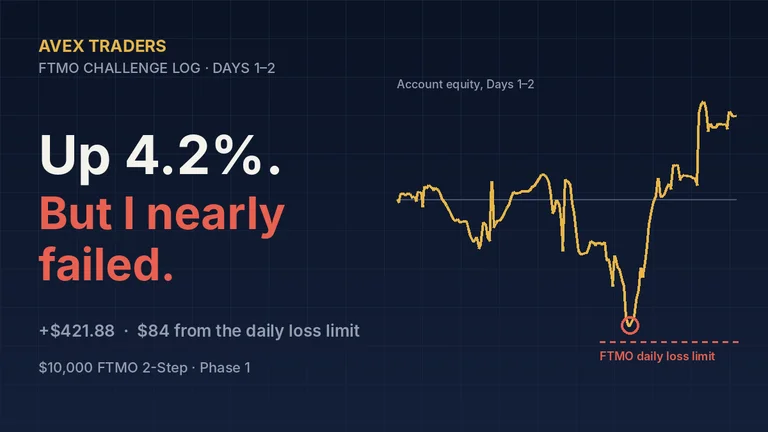
On Monday, 17 November 2026, I start a $10,000 FTMO 2-Step Challenge. I will document the journey: the rules I set for myself, the trades I take, the mistakes I make and what I learn. The goal is to work towards passing, while showing what the process actually involves, including the difficult days.
Why Consider a Prop Firm Challenge?
When you are still building confidence in your execution, protecting your personal savings matters.
A paid evaluation lets you test your trading inside a strict set of rules, with a fixed fee at risk instead of a large personal deposit. If the attempt fails, the fee is the loss. Nothing more.
But there is an important distinction: the fee limits what you can lose on one attempt. It does not make passing easy, and it does not make repeated attempts cheap.
If you fail and keep buying challenges, those fees add up fast. A challenge needs a spending limit, just as a trading account needs a loss limit. Mine is below.
If You Don't Trust Your Strategy Yet, Start Here
There are two very different kinds of uncertainty:
- "I have tested my strategy, but I struggle to follow it consistently."
- "I don't know whether my strategy works."
A paid challenge can expose execution problems in the first situation. It cannot fix the second just because money has been spent.
Before paying for any challenge, you should be able to explain your setup, entry conditions, stop placement, exit plan and risk limits, and you should have a trading record that gives you a reason to trust the method. If that is not you yet, start with a written strategy, backtesting and forward testing.
FTMO also offers a free trial with simulated funds that follows the challenge format. It does not qualify you for an FTMO account, but it is a useful rehearsal before you commit a fee.
In aviation, we use the simulator to practise procedures before taking on greater responsibility. I believe trading deserves the same preparation.
What a $10,000 FTMO Account Actually Means
The $10,000 describes the size of a simulated account. I am not depositing $10,000, I cannot withdraw $10,000, and I am not allowed to lose anything close to it.
FTMO states that its accounts use simulated funds in a simulated trading environment. Traders who pass can become eligible for performance-based rewards under FTMO's conditions and agreement.
These are the rules of the $10,000 2-Step Challenge I am taking:
| Rule | Phase 1: Challenge | Phase 2: Verification |
|---|---|---|
| Profit target | 10% ($1,000) | 5% ($500) |
| Maximum daily loss | 5% ($500) | 5% ($500) |
| Maximum total loss | 10% ($1,000) | 10% ($1,000) |
| Minimum trading days | 4 | 4 |
| Time limit | None | None |
The fee for this account size is about $99 USD at the time of writing, and on the 2-Step it is refunded with the first reward if you pass both phases and trade the funded account successfully. Prices and rules can change, so always check FTMO's own website before you buy.
I chose the 2-Step over the 1-Step for a simple reason: it allows a 5% daily loss instead of 3%, and its maximum loss is fixed rather than trailing. For a trader focused on discipline, more room to breathe is worth the extra phase.
My Personal Rules for This Challenge
FTMO's rules are the outer walls. My own rules sit well inside them:
- Risk per trade: 0.5% ($50). Fixed before entry, with the stop loss in place.
- Personal daily stop: $100. Two losing trades and I am done for the day. That is one fifth of FTMO's $500 daily limit.
- Only setups from my written plan. No trade because "it looks like it might go".
- Combined exposure stays within my risk. No stacking positions or adding to losers.
- Review before the next trade. After any mistake, I journal it before I look for another entry.
- Attempt limit: two challenges. If both attempts fail, I stop buying challenges and go back to my plan and free practice. This is my spending limit, written down before the first trade.
At $50 per trade, it would take 20 full losses in a row to hit the maximum loss. At $100 per day, a bad day can never come close to breaching the daily limit. The profit target must never become an excuse to increase risk or force trades.
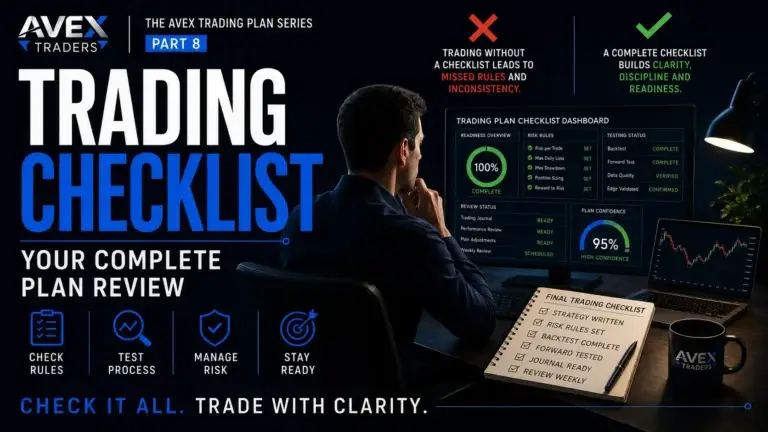
Before every trade, I will run through my pre-trade checklist. If the answer to any question is "no" or "not sure", there is no trade.
What I'll Share, and Where
I will post a short update in the Avex Traders Telegram channel on every day I trade. Each update covers:
- The setup: what I saw and why I entered.
- The risk: the amount planned and where the stop was.
- The result: profit or loss, including trading costs.
- The execution: whether I followed the plan.
- The lesson: what deserves attention next time.
Every week, I will publish a recap here on the site with the running scoreboard: balance, distance to the profit target, room left before the daily and maximum loss limits, and the rules I followed or broke. I will also run each week's trade history through my AI trading coach review and share what it finds.
Losing trades belong in the journal alongside winning ones. So do profitable trades that involved poor decisions.
When there is no suitable setup, there may be no trade. Publishing updates should never create pressure to enter the market.
Frequently Asked Questions
Is a prop firm challenge good for beginners?
Only for beginners who already have a tested strategy and want to check their execution under pressure. If you are still searching for a strategy, free practice and a written plan come first. A challenge fee does not replace preparation.
How much does a $10,000 FTMO Challenge cost?
At the time of writing, the $10,000 2-Step Challenge costs about $99 USD. On the 2-Step, the fee is refunded with your first reward. Check FTMO's website for the current price before buying.
Do you trade real money in an FTMO Challenge?
No. FTMO accounts use simulated funds. The money at risk is the challenge fee. Traders who pass can become eligible for real-money rewards based on their simulated results, under FTMO's conditions.
What happens if you fail the FTMO Challenge?
The attempt ends and the fee is lost. You can buy another challenge, which is why it is important to set an attempt limit before you start. Mine is two.
Can I copy your trades?
No, and you shouldn't. This journal is for learning, not signals. Your strategy and risk rules must fit you.
Follow the Journey
This series follows my attempt to pass a $10,000 FTMO Challenge, one trading day at a time, starting Monday, 17 November. There is no guaranteed outcome, and the journal is only useful if it stays honest.
For the wider picture of how prop firms work and why most traders still fail them, read how traders can access capital, and why most still fail.
The plan. The trades. The lessons.
This article documents my personal experience for educational purposes. It is not a recommendation to buy a challenge or to copy my trades. Challenge fees can be lost, and simulated results do not guarantee future earnings.