
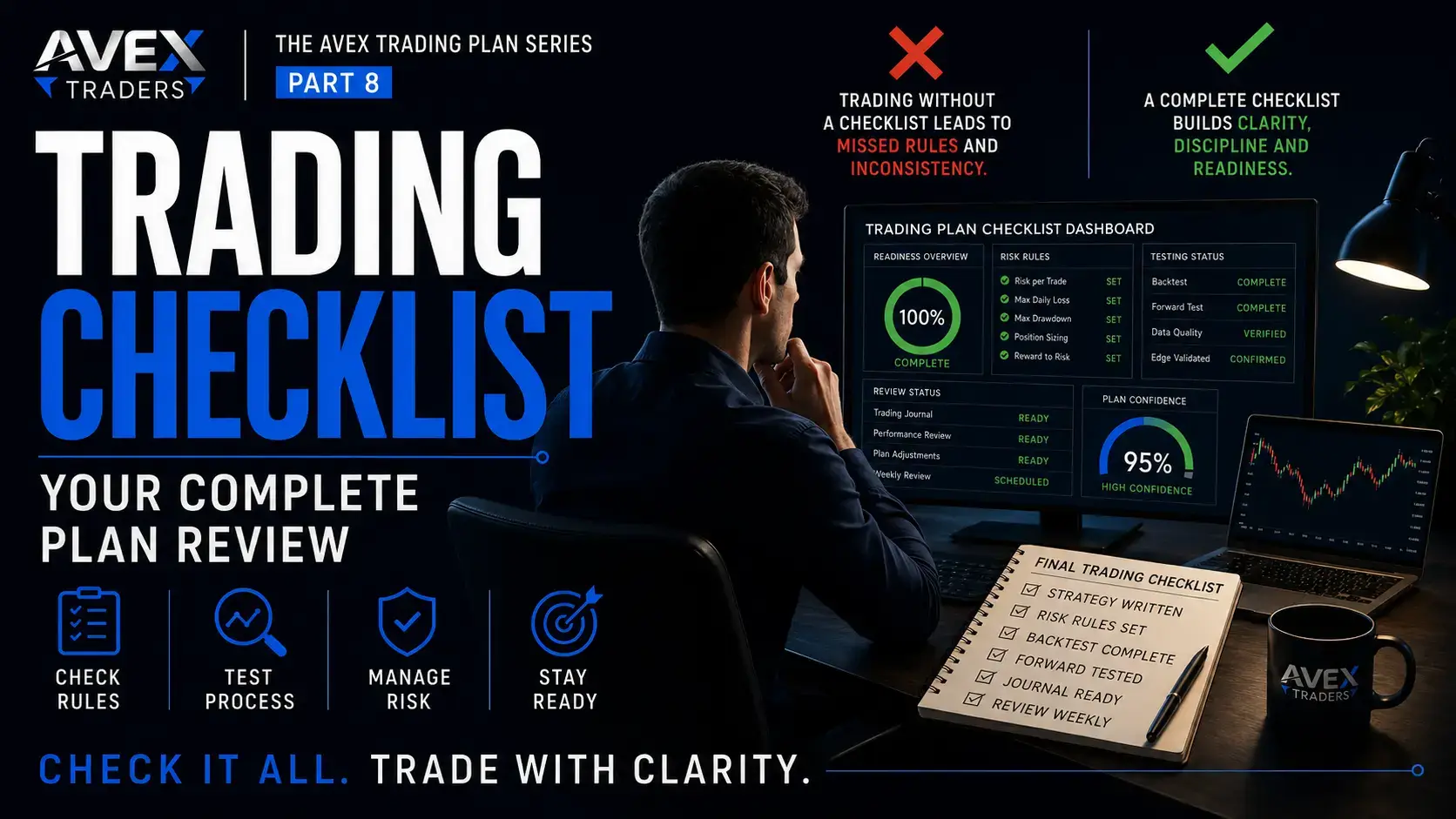
A trading strategy checklist helps a trader slow down and review the full process before risking serious capital.
Many traders want to go live too quickly.
They learn a setup.
They take a few trades.
They feel confident.
Then the market applies pressure, and the missing parts become obvious.
No written rules.
No backtesting.
No clear risk.
No journal.
No emotional control.
No review process.
This checklist is designed to prevent that.
It brings the full Avex Trading Plan Series together into one practical review.
1. Do You Have a Written Strategy?
Before live trading, your strategy must be written.
Not remembered.
Not guessed.
Not explained only in your mind.
Written.
Your strategy should clearly answer:
What market do I trade?
What timeframe do I use?
What setup am I waiting for?
What confirms entry?
Where is my stop loss?
Where is my target?
When do I stay out?
How do I manage the trade?
If your strategy cannot be written simply, it may not be ready for live execution. If you are starting here, read what a trading strategy is and why every trader needs one.
2. Is the Strategy Personal to You?
A trading strategy must fit the trader.
Your strategy should match:
- Your personality
- Your patience level
- Your schedule
- Your emotional tolerance
- Your available screen time
- Your risk comfort
- Your preferred market conditions
This is why blindly copying another trader does not work for most people. We covered this in why you should not copy another trader’s strategy.
You can learn concepts from others.
But your final rules must fit you.
A strategy you cannot follow is not useful, even if it looks profitable on paper.
3. Have You Backtested It?
A strategy should be tested before live trading.
Backtesting helps you understand how the strategy behaved in historical market conditions.
You should know:
- Win rate
- Average reward-to-risk
- Losing streaks
- Best conditions
- Weak conditions
- Common failure patterns
- Whether the setup appears often enough
Backtesting does not guarantee future results.
But it gives you evidence. Learn the full process in backtesting a trading strategy.
Without evidence, a trader is only trading belief.
4. Have You Optimised Without Overcomplicating?
After backtesting, review the results.
The goal is not to add endless filters.
The goal is to improve clarity.
Ask:
Which setups should I remove?
Which filters actually help?
Which rules create confusion?
Which conditions produce weak results?
Which setup is easiest for me to execute?
Good optimisation makes the strategy cleaner. For more, see how to optimise a trading strategy without overcomplicating it.
It should reduce hesitation, not increase it.
5. Do You Have a Written Trading Plan?
Your trading plan should explain how you operate as a trader.
It should include:
- Trading goal
- Session time
- Markets traded
- Risk per trade
- Daily loss limit
- Weekly loss limit
- Maximum trades per day
- Rules after a loss
- Rules after a win
- Rules for emotional states
- Journaling process
- Review schedule
A strategy gives trade rules.
A trading plan gives behavior rules.
You need both.
6. Are Your Risk Rules Clear?
Before every trade, you should know exactly how much you are risking.
Your checklist should confirm:
Risk per trade is defined.
Position size is calculated.
Stop loss is placed before entry.
Reward-to-risk is acceptable.
Daily loss limit is respected.
You do not increase risk emotionally.
Risk management is not optional. As we explain, risk management is more important than finding the perfect entry.
It is what keeps you in the game.
7. Have You Forward Tested?
Forward testing shows whether you can execute the strategy in current live market conditions.
Before going fully live, ask:
Have I forward tested for at least two weeks?
Did I follow the plan?
Did I journal each trade?
Did I respect risk?
Did I avoid emotional trades?
Did I trade only my session?
Did I handle losses correctly?
Forward testing is not only about profit.
It is about proving behavior.
8. Do You Keep a Trading Journal?
A trading journal should be part of your process.
Your journal should track:
- Setup
- Entry
- Exit
- Risk
- Result
- Screenshot
- Emotion
- Mistake
- Lesson
Without a journal, improvement becomes guesswork.
With a journal, your weaknesses become visible.
A journal helps you see whether the issue is strategy, execution, psychology, or risk.
9. Do You Have a Pre-Trade Checklist?
Before entering any trade, ask:
Does this setup match my strategy?
Is this inside my trading session?
Is there major news nearby?
Is my risk correct?
Is my stop loss clear?
Is my target clear?
Am I calm?
Am I chasing?
Am I following the plan?
If the answer is not clear, do not trade.
No setup is worth breaking your process.
10. Do You Know When to Stop?
A trader must know when to stop.
Your plan should define:
When to stop after losses
When to stop after reaching target
When to stop due to emotional pressure
When to stop due to poor focus
When to stop because the market is unclear
Stopping is not weakness.
Stopping is discipline.
Sometimes the best trade is no trade.
Final Trading Strategy Checklist
Before going live, confirm:
- My strategy is written.
- My rules are clear.
- My risk is defined.
- My backtesting is complete.
- My strategy has been optimised.
- My trading plan is written.
- My session is defined.
- My forward testing is complete.
- My journal is ready.
- My checklist is printed or saved.
- My emotional rules are clear.
- My review schedule is fixed.
If these are not done, the trader is not fully ready.
That does not mean failure.
It simply means more preparation is needed.
Final Thoughts
Trading is not only about finding entries.
It is about building a repeatable process.
A trading strategy checklist helps you avoid rushing into the market without structure. For a wider view, Investopedia’s guide to building a trading plan and BabyPips’ trading plan lesson are useful references.
It protects you from emotional decisions.
It reminds you to test before trusting.
It keeps your attention on execution, not prediction.
The goal is not to trade more.
The goal is to trade better.
Write the rules.
Test the rules.
Follow the rules.
Review the rules.
That is the process.
Avex Traders
Process first. Results follow.