
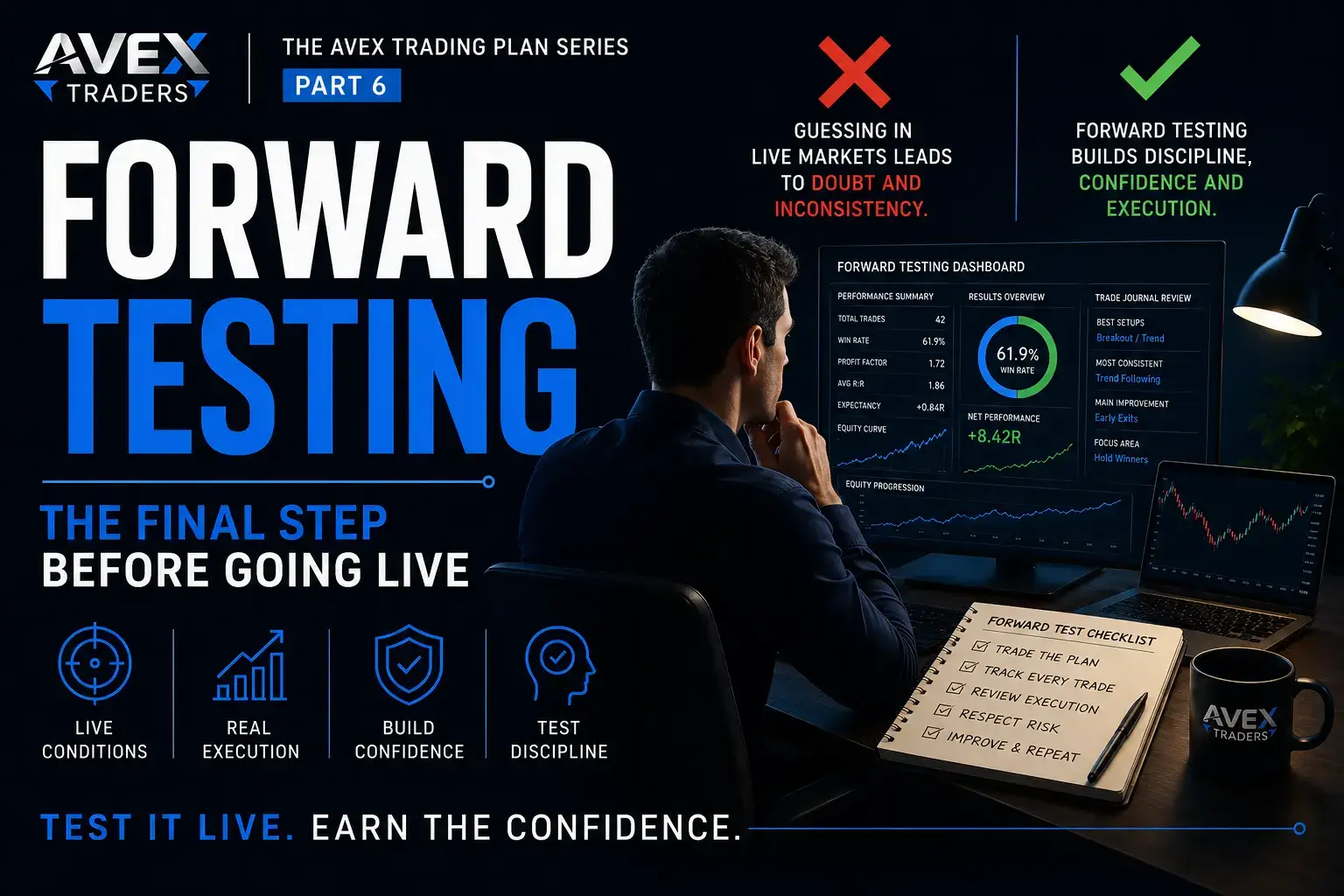
Forward testing is the final step before a trader should fully trust a strategy in live market conditions.
Backtesting helps you study the past.
Forward testing helps you deal with the present.
That difference is important.
When you backtest, you can move through months of market data quickly. You can see the next candle, the next day, and the next result in a short period of time.
But in forward testing, you must wait.
Today becomes tomorrow only after real time passes.
That waiting process tests something backtesting cannot fully test:
your patience, discipline, timing, and emotional control.
What Is Forward Testing?
Forward testing means testing your trading strategy in current live market conditions without immediately treating it like a full live account.
It is the bridge between backtesting a trading strategy and live trading.
At this stage, your strategy should already be written.
Your backtesting should already be completed.
Your trading plan should already be clear.
Forward testing is not the place to guess your rules.
It is the place to check whether you can execute those rules in real time.
Why Forward Testing Matters
Many traders feel confident after backtesting.
They see that their strategy worked on historical data, and they immediately want to go live.
But live market conditions feel different.
In backtesting, a losing day passes quickly.
In forward testing, a losing day sits with you.
You may have to wait 24 hours for the next session.
You may start doubting the system.
You may feel pressure to change the rules.
This is exactly why forward testing matters.
It reveals whether you can stay consistent when the market is moving in real time.
Backtesting Gives Evidence, Forward Testing Builds Behavior
Backtesting answers:
Did this strategy work in the past?
Forward testing answers:
Can I execute this strategy now?
Both are necessary. If you have not yet studied this stage properly, review why skipping backtesting costs traders money.
A strategy may look good on paper, but the trader may not be ready to execute it live.
Maybe the setup appears too fast.
Maybe the stop loss feels uncomfortable.
Maybe the trader hesitates.
Maybe the trader exits early.
Forward testing exposes these issues before serious capital is at risk.
That is valuable.
When Should You Start Forward Testing?
You should not start forward testing too early.
Before forward testing, you should already have:
- A written strategy
- A completed backtest
- A clear trading plan
- Defined risk rules
- A chosen market or symbol
- A chosen session
- A journaling method
If these are missing, forward testing becomes random demo trading.
That is not the goal. If you are unsure what a complete strategy looks like, start with what a trading strategy is and why every trader needs one.
Forward testing should be structured.
You are testing a specific strategy under specific conditions.
Demo or Small Real Account?
Forward testing can be done on demo or with a small real account.
For many traders, demo is the safest starting point.
But the demo account should match the size you expect to trade later.
If you plan to trade a $500 live account, do not forward test with a $50,000 demo account.
That creates unrealistic expectations.
The numbers feel different.
The emotions feel different.
The risk feels different.
Your forward testing should prepare your mind for the actual account you plan to trade. For a wider perspective on demo trading, BabyPips explains how to use a demo account well.
How Long Should You Forward Test?
A trader should forward test long enough to see different market conditions and enough trades to evaluate behavior.
Two weeks can give an early picture.
One month is better.
The goal is not only to make profit. The goal is to see whether you can follow the plan.
During forward testing, ask:
Did I follow my entry rules?
Did I respect my stop loss?
Did I risk correctly?
Did I avoid overtrading?
Did I journal every trade?
Did I stop when my plan told me to stop?
If the answer is no, the issue may not be the strategy.
It may be execution.
What to Track During Forward Testing
Forward testing should be recorded properly.
Track:
- Date
- Symbol
- Session
- Setup
- Entry reason
- Stop loss
- Take profit
- Risk amount
- Result
- Screenshot
- Emotion before entry
- Emotion during trade
- Mistake, if any
- Lesson
This creates a realistic record of your trading behavior.
Do not only track profit and loss.
Track execution quality. Remember that risk management is more important than finding the perfect entry.
A profitable forward test with poor discipline is dangerous.
A breakeven forward test with strong discipline may still show progress.
The Goal Is Consistency, Not Excitement
Some traders expect forward testing to be exciting.
It should not be.
Good forward testing is often boring.
You wait.
You follow rules.
You skip weak setups.
You accept losses.
You review.
You repeat.
This is how real trading works.
If you cannot follow the process in forward testing, live trading will expose the weakness quickly.
Do Not Use Shortcuts
Forward testing should be done in live market conditions.
Do not try to replace it with shortcuts.
The purpose is not only to see whether the strategy works. The purpose is to see whether you can operate under real-time pressure.
That pressure is part of the test.
A trader must learn to wait for the candle, wait for the setup, wait for the session, and wait for the next opportunity.
This is how discipline is built.
Final Thoughts
Forward testing is the final checkpoint before live trading.
It connects your strategy, backtesting, trading plan, risk rules, and psychology.
It shows whether your system works in real time.
It also shows whether you can follow it.
Do not rush this stage. For a broader overview of demo and forward testing before going live, see Investopedia’s explanation of practising with a demo account.
Forward testing is not a delay.
It is protection.
It protects your capital.
It protects your confidence.
And it helps you enter live trading with evidence, patience, and structure.
Avex Traders
Test the process before you trust the outcome.