How AI Trading Review Helped Me Understand My Demo Scalping Results
AI trading review can help traders understand demo scalping results, expose risky habits, and improve discipline without relying on trading signals.
This AI trading review was not about finding signals. It was about understanding the trader behind the results.
Most traders look at a trading report and ask one question:
“Did I make money?”
That is the wrong question.
The better question is:
“Was the process good enough to repeat?”
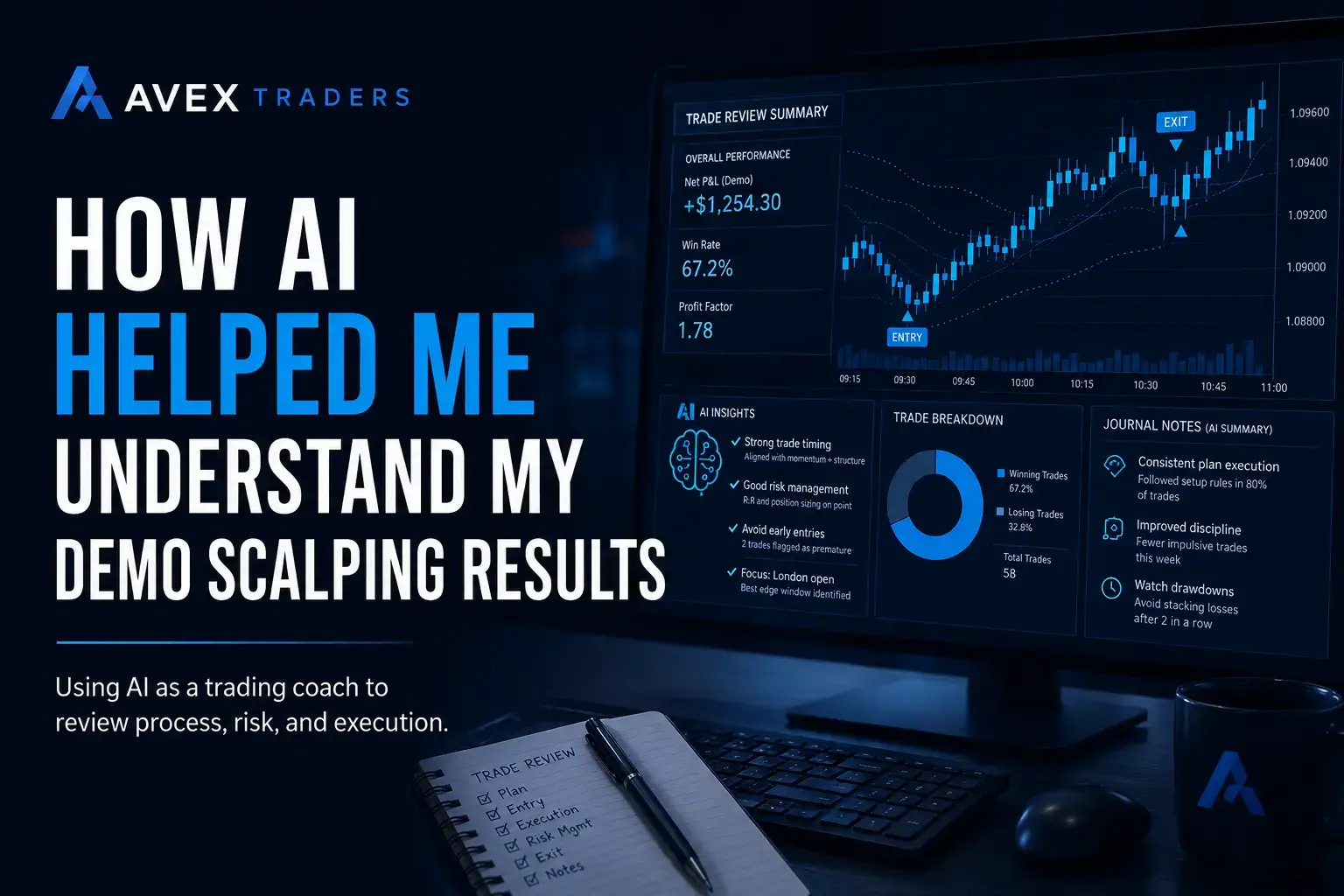
Recently, I used AI coach again as a trading coach to review my demo scalping practice on gold.
The numbers looked strong.
The account grew fast.
The win rate was high.
Some days looked impressive.
But once AI reviewed the trade history, the real lesson became clear:
👉 Profit alone does not prove mastery.
How an AI Trading Coach Reviewed My Demo Scalping Results
I had already written before about how I use AI as a trading coach — not to give me signals, but to review my behavior, risk, and execution.
This time, I wanted to go deeper.
I was practicing fast scalping on a demo account using gold.
The goal was not simply to grow the account.
The real goal was to test:
- Can I execute fast?
- Can I control risk?
- Can I avoid emotional scaling?
- Can I stop when my rules say stop?
- Can I trade smaller targets without turning every trade into a rescue mission?
That is where AI became useful again.
Not as a predictor.
As a mirror.
The Numbers Looked Strong
The demo account started with $1,000.
During the first stage, it grew to around $3,364.
The early report showed:
- 73 trades
- 83.6% win rate
- profit factor around 6.27
- net profit around $2,364
- maximum drawdown around 7.64%
On paper, that looks excellent.
Many traders would stop there and say:
“The strategy works.”
But AI helped me ask a better question:
“How was that profit made?”
That changed everything.
What AI Helped Me See
This AI trading review helped me separate strong results from risky execution.
The positive side was clear.
My price-action reading was improving.
I was not holding trades randomly for hours.
Most trades were closed quickly.
I was reading short-term waves better than before.
That was encouraging.
But AI also highlighted the uncomfortable part:
- too many trades
- aggressive scaling
- large basket exposure
- oversized positions
- recovery behavior after losses
- risk not always defined before entry
That is the power of using AI properly.
It does not get impressed by the balance curve.
It looks at the behavior behind the result.
The biggest value of AI trading review is that it separates clean execution from lucky recovery.
Profit Can Hide Bad Habits
This became the biggest lesson of the practice period.
A trader can make money and still reinforce the wrong habit.
For example:
- breaking a daily loss rule and recovering
- increasing lot size after pressure
- adding to trades without a clear second setup
- turning a scalp into a rescue basket
- continuing after already reaching a strong daily profit
When it works, it feels like confidence.
But professionally, it may be risk hiding behind profit.
AI helped me see that some of my best financial results came from behavior I should not repeat.
That is a difficult but valuable lesson.
The 20 May Example
One day was especially important.
The financial result was strong.
The account ended with a good profit, a strong win rate, and a solid profit factor.
But there was one problem.
Part of the profit came from several 1-lot trades after a losing sequence.
Those trades helped the day look excellent.
But when I asked AI to recalculate the day without those 1-lot trades, the lesson became very clear.
The profit was smaller.
But the process was better.
That was one of the most important insights:
👉 Smaller profit with a clean process is better than larger profit with dangerous sizing.
This is exactly the type of lesson traders often miss when they only look at final profit.
What AI Taught Me About Scalping
Fast scalping is different from swing trading.
In scalping, small moves matter.
A trade may only need a few candles.
A small move on gold may be enough.
A 1:1 reward-to-risk can make sense if the probability is high. Its all about risk management
But the margin for error is smaller.
Because everything happens faster:
- entries
- exits
- emotions
- mistakes
- revenge trades
- overtrading
AI helped me understand that my biggest challenge was not only reading price.
It was controlling behavior under speed and position sizing.
Frequent Trading Is Not Always Overtrading
This was another important distinction.
In fast scalping, frequent trading can be normal.
A trader may take many trades if each trade has:
- a valid setup
- clear structure
- controlled risk
- correct location
- logical exit
So the number of trades alone is not the full problem.
The real question is:
“Were the trades planned, or were they emotional?”
AI helped separate structured activity from emotional activity.
That matters because I do not want to reduce trades blindly.
I want to reduce bad trades.
Multi-Entry Is Not Always Wrong
At first, multi-entry looked dangerous.
And sometimes it was.
But when I reviewed the trades with AI, the evaluation became more balanced.
In trading ranges, multi-entry can be part of the method if it is planned.
For example:
- buying near the lower edge
- adding at a safer point
- exiting near the middle or EMA
- selling near the upper edge
That can be valid.
But only if total exposure is controlled.
The difference is simple:
Planned multi-entry is part of a strategy.
Emotional averaging is a rescue attempt.
AI helped me identify which behavior I was closer to.
That is where the real coaching happened.
The New Question I Ask After Every Session
The value of AI trading review is that it forces me to look beyond profit and examine behavior.
Before using AI this way, I mostly looked at the result.
Now I ask better questions:
- Did I follow my daily loss rule?
- Did I stop after my target?
- Did I enter at a good location?
- Did I add because of a plan or emotion?
- Did I increase size after pressure?
- Did I trade the market cycle correctly?
- Would I repeat this process 100 times?
That last question is powerful.
Because trading is not about one good day.
It is about whether the process can survive repetition.
For me, AI trading review is now part of my post-session routine.
How AI Changed My Next Rules
After the review, the next goal became clearer.
The goal is no longer:
“How fast can I grow the demo account?”
The goal is:
“Can I trade cleanly enough to trust the process?”
So the next rules are:
- smaller fixed risk
- no oversized recovery trades
- maximum daily loss
- daily profit target
- fewer open positions
- setup label before entry
- no middle-of-range trades
- stop after rule violation
- review trades after each session
This is where AI becomes useful.
It helps turn trading history into rules.
Why This Matters for Other Traders
Most traders do not need more indicators.
They need better feedback.
They need something that can look at their trade history and ask:
- Where is the risk?
- Where is the habit?
- Where is the emotional pattern?
- Where is the rule violation?
- Where is the repeatable edge?
AI can help with that.
But only if you ask it the right questions.
If you ask AI for signals, you become dependent.
If you ask AI to review your execution, you become more aware.
That is a big difference.
Final Thought
This demo scalping practice was not just about profit.
It became a test of process.
The numbers showed that I can catch moves.
But AI helped me see something more important:
👉 which parts of the process are worth keeping
👉 which parts are dangerous
👉 which habits need to be removed before live trading
That is why I believe AI can be a powerful trading coach.
Not because it predicts the market.
But because it helps you see yourself more clearly.
And in trading, that may be more valuable than another signal.
For me, AI trading review is not about prediction — it is about improving the trader behind the trades.
Avex Traders
AI should not replace your trading judgment. It should help you improve the trader behind the trades.