
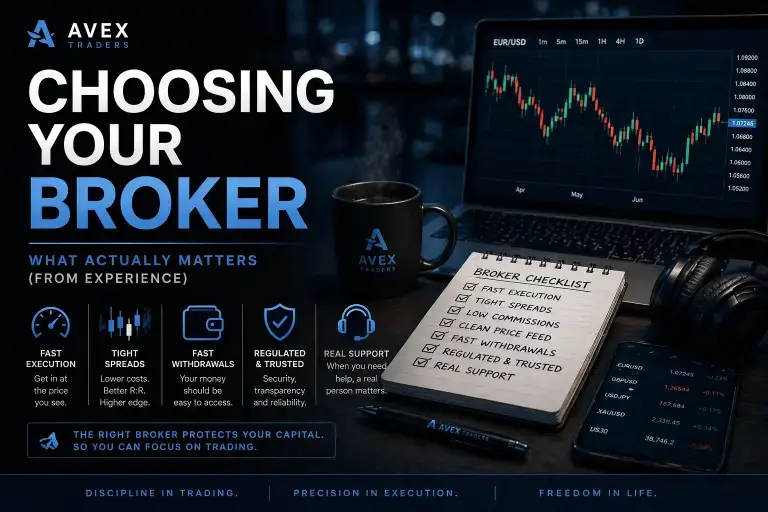
One of the mistakes I made early in trading had nothing to do with strategy.
It was the broker.
At that time, I was focused on entries, setups, and learning price action. But I didn’t realize something important:
👉 Even if your analysis is correct, a bad broker can still make you lose.
Slow execution.
Random spikes on charts.
Delays when withdrawing money.
That’s when I understood:
👉 our broker is not just a tool — it’s part of your trading system.
Before thinking about scaling or getting access to capital, you need to make sure your broker is reliable.
What a Broker Actually Does
A broker is simply your connection to the market.
They:
- execute your trades
- provide price data
- manage deposits and withdrawals
Sounds simple — but the quality of how they do this makes a huge difference.
What I Look for in a Broker (Real Checklist)
1. Execution Speed
When you enter a trade, you should get the price you see.
If your entries are consistently worse than expected, that’s not random.
👉 That’s execution quality.
Even small delays can:
- worsen your entry
- distort your stop-loss
- reduce your profit potential
2. Clean Charts (No “Fake Candles”)
If you ever see:
- random spikes hitting your stop
- candles that don’t exist on other platforms
👉 That’s a serious red flag.
Your chart should reflect the real market — not something unique to your broker.
3. Spreads & Commissions (This Impacts Your R:R Directly)
This is where many traders lose money without realizing it.
Every trade you take starts negative because of spread and commission.
👉 If spreads are wide:
- your entry becomes worse
- your stop effectively becomes smaller
- your reward gets reduced
Example:
You plan:
- Risk: 10 pips
- Reward: 20 pips (1:2 R:R)
But if your broker adds:
- 2–3 pips spread
- plus commission
👉 Your real R:R might become:
- Risk: 10 pips
- Reward: 16–17 pips
Now your system is weaker — without you changing anything.
4. Withdrawals (The Real Test)
Deposits are always easy.
Withdrawals show the truth.
A good broker:
- processes withdrawals fast
- doesn’t delay
- doesn’t create unnecessary friction
👉 If withdrawing your own money feels difficult, that’s your answer.
5. Leverage (Don’t Fall for the Trap)
High leverage looks attractive.
But in reality:
👉 it increases the chance of blowing your account.
If a broker offers extreme leverage (like 1:1000+),
it’s usually not in your favor.
6. Reputation & Track Record
Check reviews — but read them properly.
Ignore:
- emotional complaints
- unrealistic expectations
Look for patterns:
- withdrawal delays
- execution issues
- poor support
How Traders Use This in Real Trading
Most beginners focus only on strategy.
But in real trading:
👉 Execution quality + cost structure = performance
Your broker directly affects:
- entry precision
- stop-loss execution
- actual risk-to-reward (R:R)
- emotional stability
Even a good setup can fail if:
- spread is too wide
- execution is delayed
- costs eat your edge
This is where trading discipline becomes critical — especially the ability to wait for the right conditions instead of forcing trades.
Aviation Analogy (Simple & Relevant)
In aviation, systems are checked before every flight.
Not because something will go wrong —
but because if it does, the consequences are serious.
Your broker is part of your system.
If it’s unreliable, everything else becomes riskier.
Key Takeaways
- A bad broker can ruin a good trading system
- Execution speed directly impacts results
- Clean charts are non-negotiable
- Wide spreads and commissions reduce your real R:R
- Withdrawals reveal broker integrity
- High leverage is often a trap
- Your broker is part of your risk management