
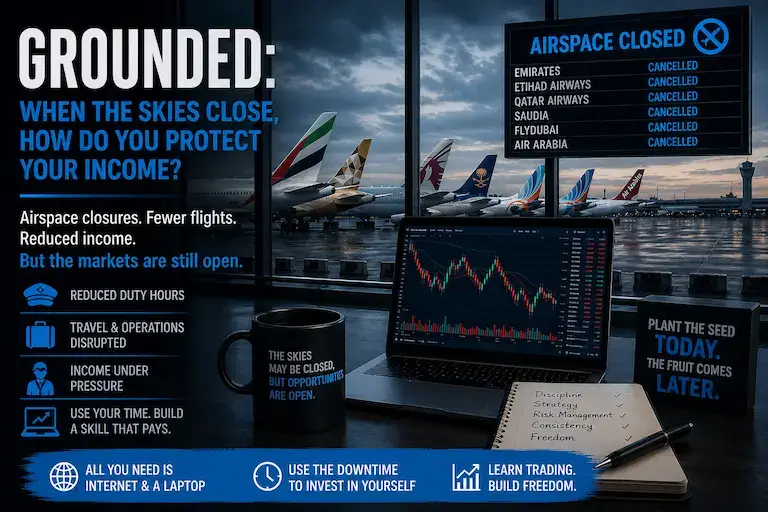
Airspace closure aviation income disruption is a serious issue for aviation professionals.
There is a surreal feeling when you open a flight radar map and see empty airspace over the Persian Gulf.
For most people, it’s just news.
But for those of us in aviation, it’s personal.
This is the real impact of airspace closure on aviation income.
How Airspace Closure Affects Aviation Income
Recent conflicts in the region have led to significant airspace restrictions and operational disruptions.
Across the industry, major carriers like Emirates, Etihad Airways, Qatar Airways, Saudia, flydubai, and Air Arabia have all been affected in different ways.
And when airlines are affected, the impact goes far beyond aircraft.
👉 Fewer flights
👉 Reduced duty hours
👉 Lower income
For cabin crew, travel agencies, and airport staff, this is not just a slowdown.
👉 It’s a direct hit to livelihood.
When your income is tied to a roster, geopolitical events can pause your financial stability overnight.
My Reality
I’m not just observing this — I’m living it.
Until recently, I had two part-time aviation consultancy roles that provided a strong additional income.
Because of the current situation, both stopped completely.
No transition. No buffer.
Just stopped.
Navigating life expenses during a period like this — when the entire industry is affected — is not easy.
The Silver Lining of an Empty Roster
But there is one thing that changed:
👉 Time
With consultancy work paused, I suddenly had more time available.
And thankfully, I had already started building a skill outside aviation:
👉 Trading
It didn’t matter that the airspace was closed.
The markets were still open.
All I needed was:
- internet
- a laptop
- and a structured approach
The Hard Truth (No Hype)
Let’s be clear:
👉 Trading is not easy
It is not a shortcut.
It is not fast money.
Like any serious business, it comes with a high failure rate.
Studies show that around 45–50% of traditional businesses fail within their first five years.
In trading, the failure rate is also very high — mainly due to:
- lack of discipline
- poor risk management
- unrealistic expectations
This is where most people fail.
Not because the opportunity isn’t real —
but because the approach is wrong.
My Experience With Other Paths
I’ve explored different income streams over the years:
- e-commerce
- social media-based businesses
- various online models
Each comes with its own challenges:
- inventory
- logistics
- customer management
- platform dependency
From my experience, trading offers a different model.
👉 It is flexible
👉 It is scalable
👉 It is independent
But only once you reach consistency.
And that part requires:
- time
- discipline
- structured execution
Why You Should Start While You Still Can
This is the most important point.
👉 Start while you still have income.
Learning trading under financial pressure leads to:
- emotional decisions
- forced trades
- poor risk control
Instead:
👉 Learn while your expenses are still covered
👉 Build skill before you need it
This is why airspace closure aviation income risk should not be ignored.
Plant the Seed Today
Trading is not something you learn in a week.
It takes time to:
- understand market behavior
- build a strategy
- develop discipline
- manage risk
The results don’t come immediately.
👉 The fruit comes later.
But starting today is always better than starting under pressure.
A Changing World
The reality is simple:
- geopolitics can stop industries overnight
- aviation is highly sensitive to global events
- income stability is no longer guaranteed
At the same time:
👉 automation and AI are changing how industries operate
Relying on a single income source is becoming riskier.
Final Thought
You cannot control:
- airspace closures
- global conflicts
- industry disruptions
But you can control:
👉 how you respond
Use this time.
Learn a skill that:
- depends on you
- scales with you
- moves with you
The skies may be closed.
👉 But the markets are still open.
Avex Traders
Trading is not about catching moves. It’s about controlling yourself.