
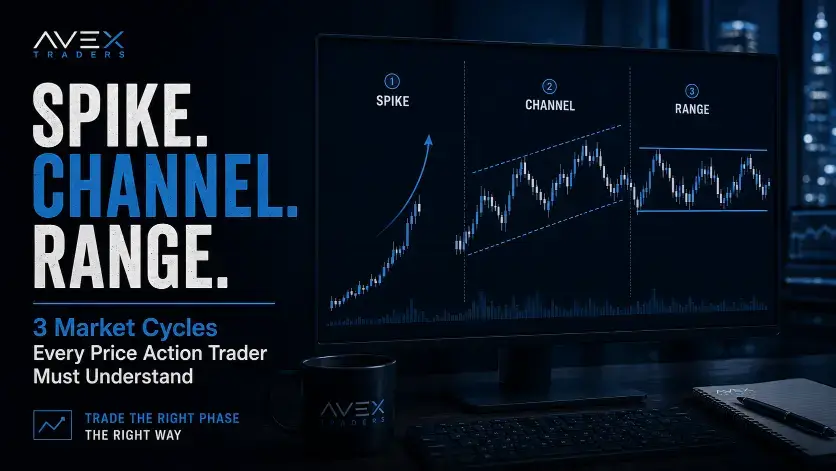
The 3 Market Cycles Every Price Action Trader Must Understand
Most traders make one major mistake:
They trade every market condition the same way.
They use the same entry logic, the same mindset, and the same expectations whether the market is moving strongly, pulling back in a channel, or moving sideways inside a trading range.
That is why a strategy can work one day and fail badly the next.
Price action is not random, but it is also not always in the same phase. One of the foundations of Al Brooks-style price action is understanding that markets often move through three main cycles:
- Spike
- Channel
- Trading Range
Each phase behaves differently.
Understanding price action market cycles helps traders know whether they should follow momentum, trade a channel, or wait for range edges.
And more importantly:
👉 each phase must be traded differently.
Why Market Cycles Matter
Before entering any trade, a trader should ask one simple question:
What type of market am I trading right now?
Because the same setup can mean different things depending on the market cycle.
For example:
- buying a pullback during a strong spike can make sense
- buying the middle of a trading range is usually poor execution
- fading a strong spike can be dangerous
- chasing the top of a channel can lead to bad entries
The market cycle gives context.
Without context, traders are only reacting to candles.
1. The Spike: When One Side Is in Control
A spike is a strong directional move.
It usually appears as a series of strong candles with little overlap. Price moves quickly, urgency increases, and one side clearly dominates.
In a bullish spike, buyers are aggressive.
In a bearish spike, sellers are aggressive.
This is the phase where the market is showing strong conviction.
How to Trade a Spike
In a spike, the basic rule is simple:
👉 trade only in the direction of the spike
If the market is strongly bullish, you do not look for the top.
If the market is strongly bearish, you do not try to catch the bottom.
This is where many traders get hurt.
They see price moving fast and think:
“It has gone too far. It must reverse.”
But strong moves can continue much longer than expected.
In a spike, the safer approach is to wait for a small pullback or continuation setup and look to join the dominant direction.
Common Mistake in a Spike
The biggest mistake is trying to fade strength too early.
For example:
- selling a strong bullish spike because price “looks high”
- buying a strong bearish spike because price “looks low”
- assuming every sharp move must reverse immediately
A spike is not the place for ego.
It is the place to respect momentum.
2. The Channel: When the Trend Becomes More Controlled
After a spike, the market often transitions into a channel.
A channel still has direction, but it is weaker than a spike.
Price continues moving up or down, but with more pullbacks, more overlap, and more two-sided trading.
In a bullish channel, price moves upward but keeps pulling back.
In a bearish channel, price moves downward but keeps bouncing.
This is where execution becomes more delicate.
How to Trade a Channel
In a channel, you should not chase price.
Instead, you wait for price to reach better locations.
In a bullish channel:
👉 look to buy near the lower part of the channel
👉 take profit or reduce risk near the upper part
In a bearish channel:
👉 look to sell near the upper part of the channel
👉 take profit or reduce risk near the lower part
The channel is still trending, but the move is no longer as clean as the spike.
That means traders must be more patient.
Common Mistake in a Channel
The biggest mistake is entering too late.
Many traders see the trend and buy near the top of a bullish channel.
Then price pulls back.
They were right about direction, but wrong about location.
That is a very important lesson:
👉 good bias does not fix poor entry location
In a channel, location matters more than excitement.
3. The Trading Range: When the Market Has No Clear Direction
Eventually, many trends lose momentum and enter a trading range.
This is where price moves sideways between support and resistance.
Neither bulls nor bears are fully in control.
Buyers appear near the bottom.
Sellers appear near the top.
The middle of the range is usually the worst place to trade because direction is unclear.
How to Trade a Trading Range
In a trading range, the core principle is:
👉 BLSH — Buy Low, Sell High
That means:
- buy near the bottom of the range
- sell near the top of the range
- avoid trading in the middle
- be careful with breakout attempts
Most beginners do the opposite.
They buy high because price looks like it is breaking out.
Then price reverses back into the range.
Or they sell low because price looks weak.
Then price bounces.
A trading range rewards patience and punishes chasing.
Common Mistake in a Trading Range
The biggest mistake is treating a range like a trend.
In a trend, continuation trades can work.
But in a range, continuation often fails.
That is why many breakout traders struggle in sideways markets.
They keep expecting expansion, but the market keeps returning to the middle.
In a trading range, the market is telling you:
👉 do not chase
👉 wait for the edges
👉 buy low, sell high
How the Three Cycles Connect
The market often moves like this:
Spike → Channel → Trading Range
A strong breakout creates the spike.
Then the market continues in a channel.
Eventually, momentum weakens and price enters a range.
But the market does not always follow this perfectly.
Sometimes a trading range breaks into a new spike.
Sometimes a channel accelerates into another spike.
Sometimes a failed breakout returns directly into a range.
The point is not to predict perfectly.
The point is to recognize the current environment and adjust your behavior.
The Trader’s Main Question
Before every trade, ask:
Am I trading a spike, a channel, or a trading range?
Then ask:
Does my trade idea match this cycle?
If the answer is no, do not trade.
This one habit can prevent many unnecessary losses.
A Simple Aviation Perspective
A pilot does not fly the same way in takeoff, cruise, and approach.
Each phase has different procedures.
Trading is similar.
A spike, a channel, and a trading range are different market environments.
If you use the wrong procedure in the wrong phase, the risk increases.
Key Takeaways
- Markets often move through three cycles: spike, channel, and trading range
- A spike should usually be traded only in the direction of the move
- A channel requires better entry location and more patience
- A trading range is best approached with BLSH: buy low, sell high
- The middle of a range is usually dangerous
- A good setup still needs the right market context
- Before entering, always identify the current cycle
Final Thought
Price action is not only about reading candles.
It is about understanding the environment.
The same trade idea can be strong in one market cycle and weak in another.
That is why professional traders do not just ask:
“Should I buy or sell?”
They ask:
👉 What phase is the market in?
Once you understand the cycle, your entries become more selective, your risk becomes clearer, and your trading becomes less emotional.
Avex Traders
Trading is not about reacting to every candle. It is about understanding the market environment before you act.