
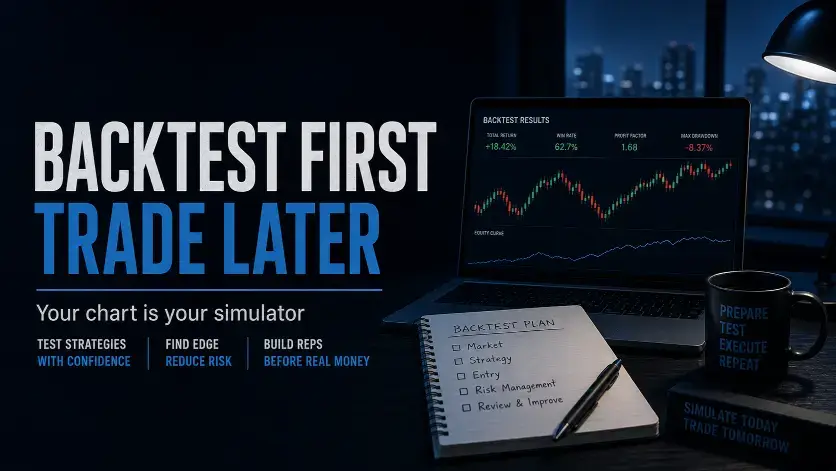
The Simulator Phase: Why Skipping Backtesting Costs Traders Money
When I first started my trading journey, I was hungry for knowledge.
I took a detailed price action course based on the Al Brooks method. The course was structured, serious, and taught by someone who clearly understood the market.
But there was one instruction the instructor repeated after almost every lesson:
👉 “Now go and practice this on the chart.”
And that is exactly what I did not do.
I would watch the lesson, understand the idea, and think:
“This looks easy. Let’s move to the next one.”
So I kept watching.
I kept learning.
But I was not practicing.
Then I started trading live.
And I started losing.
Not because the course was bad.
Not because price action did not work.
But because I had knowledge without execution skill.
Understanding Is Not the Same as Execution
This is one of the biggest traps in trading.
You watch a lesson.
You understand the setup.
You recognize the logic.
And your brain tells you:
👉 “I got this.”
But live trading is different.
When real money is involved, everything changes:
- hesitation appears
- fear enters
- entries become unclear
- stop losses feel personal
- doubt takes over
That is why simply watching trading videos is not enough.
Trading is not only knowledge.
👉 Trading is a skill.
And skills need repetition.
Backtesting Is Your Trading Simulator
In aviation, a pilot does not read a manual and then fly a commercial aircraft immediately.
They train in simulators.
They repeat procedures.
They practice emergency scenarios.
They build reactions before facing real pressure.
Trading works the same way.
👉 Backtesting is your simulator.
It allows you to test your strategy before risking real money.
It helps you answer important questions:
- Does this setup actually work?
- What is the win rate?
- What is the average risk-to-reward?
- What kind of drawdown should I expect?
- Can I recognize the setup clearly?
Without this data, you are not trading a strategy.
You are guessing.
The Proper Progression Before Going Live
If I could go back, I would not rush to live trading.
I would follow this process first.
1. Write the Trading Plan
Before any trade, your strategy must be written.
Not in your head.
Written.
Your plan should define:
- instrument
- timeframe
- setup conditions
- entry rules
- stop-loss rules
- take-profit rules
- invalidation
- maximum risk per trade
If it is not written, it is not a plan.
It is only an idea.
2. Backtest at Least 100 Trades
Once the plan is written, test it manually.
Go through at least 100 historical trades.
Track:
- wins
- losses
- risk-to-reward
- losing streaks
- mistakes
- conditions where the setup works best
This step builds data.
More importantly, it builds trust.
Because when you later face a losing trade, you are not emotionally surprised.
You already know losses are part of the system.
3. Trade It on Demo for One Month
After backtesting, move to a demo account.
Not forever.
But long enough to see whether your live execution matches your backtested results.
One month is a good starting point.
During this phase, your goal is not profit.
Your goal is execution.
Can you follow the plan when price is moving live?
Can you avoid random entries?
Can you stop after your rules say stop?
That is what demo trading is for.
4. Go Live With Minimum Lot Size
Only after your demo results match your backtesting should you go live.
And even then:
👉 start with the minimum lot size.
The goal is not to make big money immediately.
The goal is to build trust in yourself.
Real money changes psychology.
Even small size teaches you how you behave under pressure.
This is where you slowly build confidence.
Backtesting Never Really Stops
The interesting part is this:
Backtesting is not something you do once and forget.
It continues.
Professional athletes do not stop training after they become successful.
They still go to the gym.
They still practice drills.
They still review performance.
Traders should do the same.
Markets change.
Volatility changes.
Sessions behave differently.
Certain setups work better in some conditions and worse in others.
Backtesting helps you find filters.
It helps you reduce bad entries.
It trains your eyes to recognize patterns.
It gives your brain repetition until execution becomes more natural.
One Important Rule
If you change your written trading plan, even slightly, you are no longer trading the same strategy.
Changing:
- stop-loss placement
- entry trigger
- timeframe
- session
- take-profit logic
- risk rules
means you have created a new version of the strategy.
And that new version needs to be tested again.
This is where many traders fool themselves.
They keep changing rules in live markets, but still believe they are trading the same system.
They are not.
The Real Lesson
Most of us want to believe we are different.
We think:
👉 “I can learn faster.”
👉 “I understand this already.”
👉 “I don’t need so much practice.”
I thought the same.
But the market does not reward confidence without preparation.
The market rewards tested execution.
The more time you spend backtesting, the less money you unnecessarily give to the market.
Final Thought
Trading is a journey.
It is not something you master by watching videos or collecting strategies.
It is a skill built through repetition, testing, journaling, and discipline.
Backtesting may feel boring.
But boring work protects your capital.
And in trading, protecting your capital is what keeps you in the game long enough to improve.
Avex Traders
Trading is not about knowing more. It is about executing better.