
[fusion_builder_container type=”flex” hundred_percent=”no” equal_height_columns=”no” hide_on_mobile=”small-visibility,medium-visibility,large-visibility” background_position=”center center” background_repeat=”no-repeat” fade=”no” background_parallax=”none” parallax_speed=”0.3″ video_aspect_ratio=”16:9″ video_loop=”yes” video_mute=”yes” border_style=”solid”][fusion_builder_row][fusion_builder_column type=”1_1″ type=”1_1″ layout=”1_1″ background_position=”left top” border_style=”solid” border_position=”all” spacing=”yes” background_repeat=”no-repeat” margin_top=”0px” margin_bottom=”0px” animation_speed=”0.3″ animation_direction=”left” hide_on_mobile=”small-visibility,medium-visibility,large-visibility” center_content=”no” last=”true” hover_type=”none” first=”true” min_height=”” link=””][fusion_text]
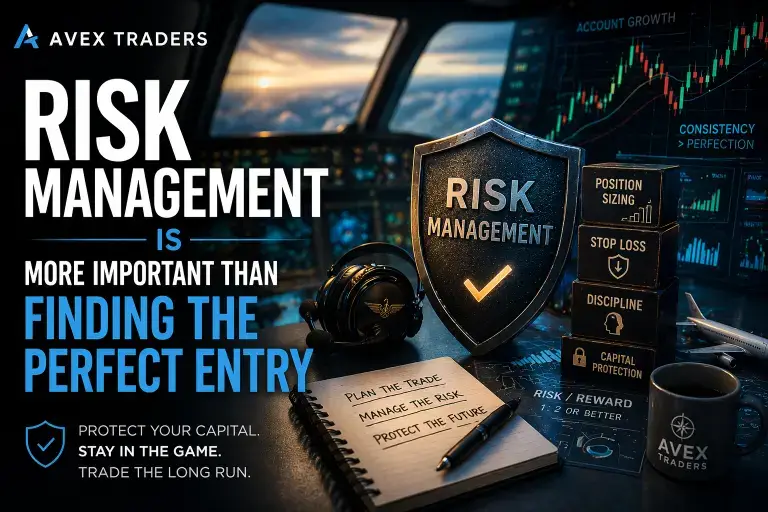
Risk Management Is More Important Than Finding the Perfect Entry
Many traders spend a great deal of time trying to find the perfect entry — often driven by the same misconceptions explained in Why Most New Traders Lose Money Before They Learn Discipline. They search for the cleanest candle pattern, the most accurate indicator, or the ideal confirmation that will help them enter a trade at exactly the right moment.
While entries do matter, they are not the most important part of long-term survival in trading.
Risk management matters more.
A trader can have a very good entry and still lose control of the trade if the risk is too large. On the other hand, a trader with an average entry can still perform responsibly if the position size is controlled, the stop loss is respected, and the overall plan is followed with discipline.
This is one of the biggest misunderstandings among beginners. Many believe the secret to consistency is finding a setup that rarely loses. In reality, losses are part of trading. The goal is not to avoid every losing trade. The goal is to make sure that one loss does not damage your account, your confidence, or your discipline.
That is where risk management becomes essential.
Risk management is not only about placing a stop loss. It is about deciding in advance how much of your capital you are willing to risk on a single idea. It is about making sure that no single trade has the power to cause serious damage. It is also about accepting uncertainty and understanding that even a valid setup can fail.
Without proper risk control, emotions become stronger. Fear increases when the trade size is too large. Greed increases when traders try to recover losses too quickly. This often leads to moving stops, closing trades impulsively, or taking new trades for the wrong reasons.
Good risk management creates emotional stability — something that becomes much easier when you learn to wait for the right opportunities, as discussed in Why Waiting Is the Hardest Skill in Trading.
When the amount at risk is reasonable, the trader can think more clearly. A losing trade becomes easier to accept. A winning trade becomes easier to manage. Decisions improve because they are based more on process and less on pressure.
This is why many experienced traders focus less on being right and more on managing exposure. They know that consistency does not come from predicting every move correctly. It comes from controlling losses, protecting capital, and staying in the game long enough to improve.
A strong trading habit is to think in percentages rather than in money or excitement. Instead of asking, “How much can I make from this trade?” it is often better to ask, “How much am I willing to lose if I am wrong?” That one shift in thinking can change the entire approach to trading.
Over time, good risk management does more than protect the account. It protects the trader’s mindset. It reduces stress, improves discipline, and makes it possible to learn from mistakes without constant emotional damage.
A perfect entry may look impressive, but it is not what keeps a trader alive.
Risk management does.
[/fusion_text][/fusion_builder_column][/fusion_builder_row][/fusion_builder_container][fusion_global id=”1377″]